70 Powerful Examples of Personification with Explanations (Complete Guide
Examples of Personification with Explanations show how non-human things act like humans. Writers give emotions, actions, and feelings to objects, animals, and ideas. This makes sentences more lively and easy to understand.
Imagine the sun smiling or the wind whispering softly. These simple ideas make writing fun and interesting. Personification helps readers see and feel the scene clearly.
Examples of Personification with Explanations help students improve writing skills. They also make stories, poems, and essays more creative. Learning these examples builds imagination and strong English writing.
What is Personification?
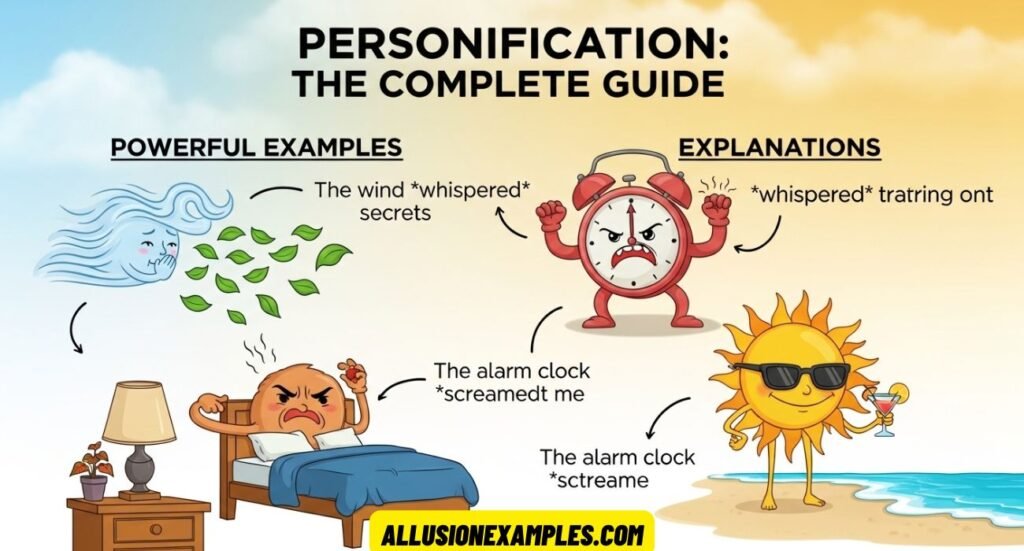
What is personification? Personification is a Personification figure of speech where human qualities are given to animals, objects, nature, or abstract ideas. The Personification meaning is simple: when something non-human behaves like a human, it becomes personification.
The Personification definition in simple English is when writers give human emotions, actions, or characteristics to non-human things. This Personification literary device is widely used in creative writing examples, poetry, storytelling, and everyday language.
For example, when someone says the wind whispered, the wind is not actually whispering. Instead, the writer uses descriptive language examples to create a vivid image.
Some Easy personification examples include:
The sun smiled down on us.
The wind whispered through the trees.
The flowers danced in the breeze.
These are simple Personification examples in English that show how writers use imagination to improve writing.
Understanding How to use personification helps writers create emotional connections and improve writing style techniques. This is why teachers often include Personification examples for students and Personification examples for kids when teaching English grammar figures of speech.
Examples of Personification
There are many Personification examples in writing that appear in daily life, books, poems, and stories. These Personification examples list help writers improve creativity and build stronger writing techniques for students.
These Personification examples sentences show how objects come alive:
The alarm clock screamed at me.
The rain tapped gently on the window.
The stars winked at us.
The moon followed me home.
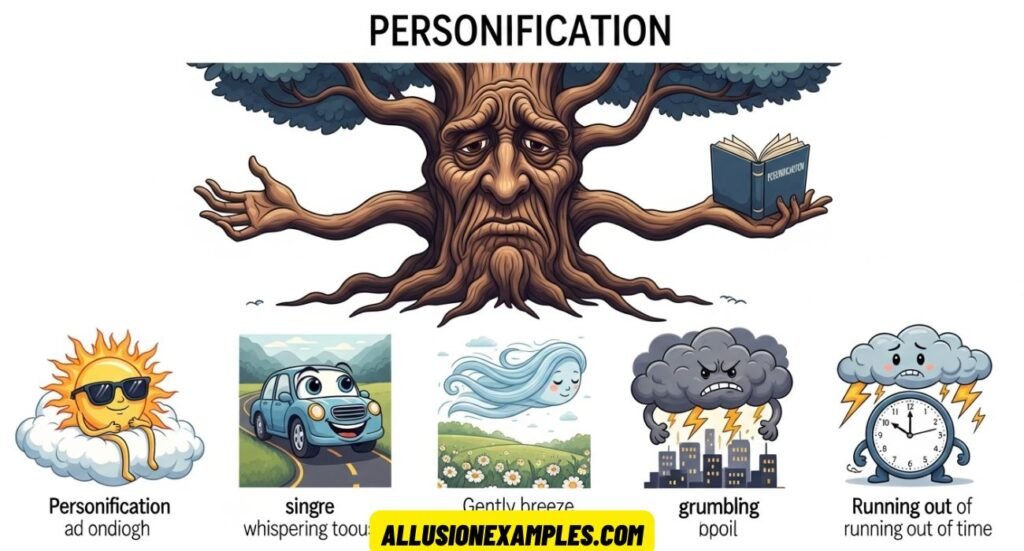
The thunder grumbled angrily.
These Personification examples in daily life help readers understand emotions and create vivid mental pictures. Writers use them as part of literary techniques list and figurative language for students.
Why Do Writers Use Personification?
Writers use personification because it makes writing more interesting and easier to imagine. When objects and ideas behave like humans, readers connect emotionally with the text. This technique is often used in creative writing techniques, storytelling, and poetry.
Personification helps create strong imagery and emotional depth. It also improves English writing tips by making writing more expressive. Writers often use personification to enhance descriptive writing techniques and storytelling techniques.
For example, instead of saying the rain was heavy, a writer may say the rain attacked the streets. This version creates a stronger emotional reaction.
Personification also helps writers explain abstract ideas. When time is described as running away, readers understand urgency. This is why Personification examples in poems and Personification examples in poetry are widely used.
Examples of Personification in a Sentence
Here are some Examples of personification in sentences that demonstrate this powerful technique:
The leaves danced in the wind.
The sun peeked through the clouds.
The river raced through the valley.
The door complained when opened.
The snow hugged the earth.
These Personification examples sentences show how non-human objects perform human actions. This improves creative writing examples and makes writing more engaging.
What Are the Examples of Personification in Literature?
Personification in literature is commonly used by famous writers. Many Famous personification examples come from poetry and classic books. These literary devices examples help writers express emotions and create memorable imagery.
1. William Wordsworth – “I Wandered Lonely as a Cloud”
William Wordsworth wrote one of the most famous Personification examples in poems:
“Ten thousand saw I at a glance,
Tossing their heads in sprightly dance.”
In this example, daffodils are described as dancing. Flowers cannot dance, but this Personification literary device creates movement and beauty.
2. Emily Dickinson – “Because I could not stop for Death”
Emily Dickinson uses personification by describing death as a person.
“Because I could not stop for Death –
He kindly stopped for me –”
Death is described as a polite gentleman. This is one of the most powerful Personification examples in poetry.
3. William Shakespeare’s play Romeo and Juliet
William Shakespeare uses personification in the line:
“When well-appareled April on the heel
Of limping Winter treads.”
Here, April and Winter behave like people. This is one of the most famous figurative language examples in literature.
See Also : 70+ Common Symbols in Literature: Unlock Hidden Meanings (Amazing Guide)
Examples of Personification in a Sentence
More Personification examples in writing include:
The city never sleeps.
The waves chased each other.
The fire danced in the fireplace.
The shadows crept across the wall.
The wind howled loudly.
These examples show how writers use poetic devices examples to improve storytelling.
Common Examples of Personification for Students
These Personification examples for students help beginners understand this concept easily:
The moon watched over us.
The sun smiled warmly.
The storm shouted loudly.
Time marched forward.
The snow covered the earth gently.
These Personification examples for kids are simple and useful for learning English grammar figures of speech.
Examples of Personification in Poetry
Poets use personification to create rhythm and emotion. These Personification examples in poetry show creative imagination.
Hope whispered softly.
Fear crept into my heart.
Joy danced in the sunlight.
Love sang quietly.
Sadness followed me home.
These Personification examples in poems help writers create emotional depth.
Difference Between Personification and Other Figures of Speech
Personification is different from metaphor and simile. Understanding metaphor vs personification and simile vs personification helps writers choose the right technique.
| Figure of Speech | Example | Explanation |
| Personification | The wind whispered | Human quality given |
| Metaphor | Time is money | Direct comparison |
| Simile | As brave as a lion | Uses like or as |
| Anthropomorphism | Talking animals | Full human traits |
These comparisons help distinguish anthropomorphism examples from personification.
List of 70+ Examples of Personification
Below are 70 Powerful Examples of Personification with Explanations:
| Personification Example | Explanation |
| The wind whispered | Wind given human voice |
| The sun smiled | Sun given emotion |
| The stars winked | Stars act like humans |
| The rain cried | Rain given emotion |
| The thunder grumbled | Thunder acts like human |
| The leaves danced | Leaves given movement |
| The moon followed me | Moon acts like person |
| The river raced | River given action |
| The door protested | Door acts like human |
| The clock stared | Clock given human action |
| The city slept | City given human trait |
| The fire danced | Fire given movement |
| The snow hugged | Snow given emotion |
| The wind sang | Wind given voice |
| The trees waved | Trees given action |
| The ocean roared | Ocean given voice |
| The flowers nodded | Flowers act human |
| The sun peeked | Sun acts like child |
| The storm marched | Storm given action |
| The rain kissed | Rain given affection |
| The clouds cried | Clouds given emotion |
| The road stretched | Road acts like human |
| The mountain stood proud | Mountain given pride |
| The waves danced | Waves given action |
| The shadows crept | Shadows given movement |
| The night swallowed | Night given action |
| The fog hugged | Fog given emotion |
| The thunder shouted | Thunder given voice |
| The earth sighed | Earth given emotion |
| The wind played | Wind given action |
| The stars danced | Stars given action |
| The moon hid | Moon given action |
| The car complained | Car given emotion |
| The phone died | Phone given human trait |
| The alarm screamed | Alarm given voice |
| The door groaned | Door given voice |
| The stairs creaked | Stairs act human |
| The river laughed | River given voice |
| The forest whispered | Forest given voice |
| The sun laughed | Sun given emotion |
| The wind cried | Wind given emotion |
| The rain tapped | Rain given action |
| The snow danced | Snow given action |
| The night whispered | Night given voice |
| The clouds marched | Clouds given action |
| The waves sang | Waves given voice |
| The earth danced | Earth given action |
| The storm roared | Storm given voice |
| The thunder laughed | Thunder given emotion |
| The fog crept | Fog given movement |
| The breeze kissed | Breeze given affection |
| The stars watched | Stars given action |
| The moon smiled | Moon given emotion |
| The ocean waved | Ocean given greeting |
| The mountain watched | Mountain given action |
| The river sang | River given voice |
| The wind laughed | Wind given emotion |
| The snow whispered | Snow given voice |
| The sky cried | Sky given emotion |
| The night danced | Night given action |
| The clouds whispered | Clouds given voice |
| The rain danced | Rain given movement |
| The sun stretched | Sun given human action |
| The shadows danced | Shadows given action |
| The wind sighed | Wind given emotion |
| The forest slept | Forest given trait |
| The thunder marched | Thunder given action |
| The moon watched | Moon given action |
| The river whispered | River given voice |
Practice Activity: Create Your Own Personification
To improve creative writing techniques, try creating your own personification. Choose an object, idea, or natural element. Then give it human emotions or actions. This exercise improves writing techniques for students and helps build creativity.
For example, you might write that time whispered in your ear. You could also describe the sun laughing or the rain dancing. Practicing these descriptive language examples helps writers improve imagination and writing skills.
Personification in Everyday Life
Personification appears in daily conversations more often than most people realize. When someone says the alarm clock screamed or the sun smiled, they are using personification naturally. These expressions help people communicate feelings and experiences more vividly. Everyday language becomes more expressive and easier to understand through this creative writing technique.
Writers often use everyday personification to make their writing relatable. It allows readers to connect with familiar experiences and emotions. This method strengthens storytelling and improves descriptive writing techniques. When used carefully, personification transforms ordinary situations into memorable moments that capture attention and enhance communication.
How Personification Improves Writing Skills
Personification helps writers improve clarity and creativity. By giving life to objects and ideas, writers can describe situations in a more engaging way. This technique encourages imagination and allows readers to visualize scenes clearly. As a result, writing becomes more interesting and emotionally powerful.
Students and writers use personification to develop their writing style. It helps improve storytelling techniques and enhances descriptive language. When writers practice personification regularly, they become more confident in their expression. This makes their writing more compelling and enjoyable for readers.
Personification in Storytelling
Storytelling becomes more engaging when personification is used effectively. Writers often give emotions to nature, objects, or abstract ideas. This technique helps readers connect emotionally with the story. It also creates vivid imagery that keeps readers interested.
Many famous stories use personification to create memorable scenes. For example, describing the wind as whispering adds mystery. This creative technique improves narrative flow and strengthens emotional connection. Storytelling becomes more immersive and enjoyable for readers.
Personification in Academic Writing
Personification is not limited to creative writing. It is also used in academic writing to simplify complex ideas. Writers often describe abstract concepts using human traits. This approach makes explanations clearer and easier to understand.
Teachers encourage students to use personification carefully in essays. It helps make arguments more engaging and memorable. However, writers should avoid excessive use in formal writing. Balanced use improves clarity without losing professionalism.
See Also : Personality Adjectives to Describe a Person – With Examples (Complete Guide)
Personification in Children’s Literature
Children’s books often rely heavily on personification. Talking animals, smiling suns, and dancing clouds capture children’s imagination. This technique makes stories more fun and easier for young readers to understand.
Authors use personification to teach lessons in a simple way. Children connect emotionally with characters that show human behavior. This improves reading comprehension and encourages creativity. Personification helps make learning enjoyable for children.
Personification in Poetry
Poets frequently use personification to create emotion and rhythm. Giving human qualities to abstract ideas allows poets to express feelings deeply. This technique enhances imagery and creates memorable lines.
Personification also helps poets convey complex emotions. Describing sadness as creeping into the heart creates a powerful image. Poetry becomes more expressive and meaningful through this literary device.
Personification in Advertising
Advertising often uses personification to make products memorable. Brands describe products as friendly, helpful, or energetic. This technique builds emotional connections with customers.
Personification makes advertisements more engaging and persuasive. When products seem alive, consumers relate to them more easily. This creative method improves marketing effectiveness and brand recognition.
Personification in Literature
Many famous authors use personification in literature. This technique helps create vivid imagery and emotional depth. Writers describe nature, time, and emotions as living beings.
Literary works become more engaging through personification. Readers experience stories more vividly and emotionally. This makes literature memorable and impactful.
Common Mistakes When Using Personification
Writers sometimes overuse personification, which can confuse readers. Too many human traits given to objects may reduce clarity. It is important to use this technique carefully.
Another mistake is using personification without purpose. Writers should ensure it enhances meaning. Balanced use improves writing quality and readability.
Personification vs Other Literary Devices
Personification is often confused with metaphors and similes. While similar, each device has unique characteristics. Personification gives human traits to objects.
Understanding these differences improves writing accuracy. Writers can choose the most suitable device for their purpose. This enhances clarity and creativity.
Benefits of Using Personification
Personification makes writing more engaging and vivid. It improves storytelling and strengthens emotional connection. Readers visualize scenes more clearly.
Writers use personification to simplify complex ideas. This makes communication more effective. The technique enhances creativity and readability.
Tips for Using Personification Effectively
Writers should use personification naturally and sparingly. It should enhance meaning without overwhelming readers. Clear and simple expressions work best.
Practicing personification regularly improves writing skills. Writers should experiment with different ideas. This helps develop creativity and confidence.
FAQs
What are 5 examples of personification in sentences?
The wind whispered through the trees, the sun smiled brightly, the clock stared at me, the flowers danced in the breeze, and the thunder grumbled loudly.
Each sentence gives human actions to non-human things, making them clear examples of personification.
What are 5 examples of personification Brainly?
The moon watched over us, the rain kissed the ground, the fire danced in the fireplace, the stars winked at us, and time flew quickly.
These simple examples help students understand personification easily.
What is a personification Grade 5 example?
Personification is when non-human things act like humans.
Example: The sun smiled at me, where the sun is given a human action.
How do you identify personification?
Look for non-human objects like animals, nature, or ideas acting like humans.
If something non-human shows feelings, emotions, or actions, it is personification.
Conclusion
Personification makes writing lively and interesting. Writers give human actions to objects, animals, and ideas. This technique helps readers imagine scenes clearly. Students improve their creativity by learning Examples of Personification with Explanations. These examples show how words can paint pictures in the reader’s mind. Personification also improves storytelling and descriptive writing. Young learners can use it in essays, poems, and stories. Practice helps students understand this literary device better.
Learning Examples of Personification with Explanations helps students grow their writing skills. They learn to use simple sentences with strong meaning. Personification also builds confidence in English writing. Students express feelings and ideas in a creative way. This technique makes writing more fun and easy. With regular practice, students develop better vocabulary and imagination. Personification remains a powerful tool for every young writer.